



For more than 30 years, physicians have been using stereotactic radiosurgery to destroy tumors in the brain. While the procedure does not remove a tumor, it can destroy tumor cells or stop growth of active tissue.
In stereotactic radiosurgery, high dose focused radiation beams are fired into a tumor from many angles. With older systems, such as the Gamma Knife, a metal frame is screwed into the patient’s head to immobilize the patient during treatment. Wearing this head frame is uncomfortable and limits the potential application of the Gamma Knife to single treatments, used against lesions within the brain or skull base.
A FRAMELESS ALTERNATIVE
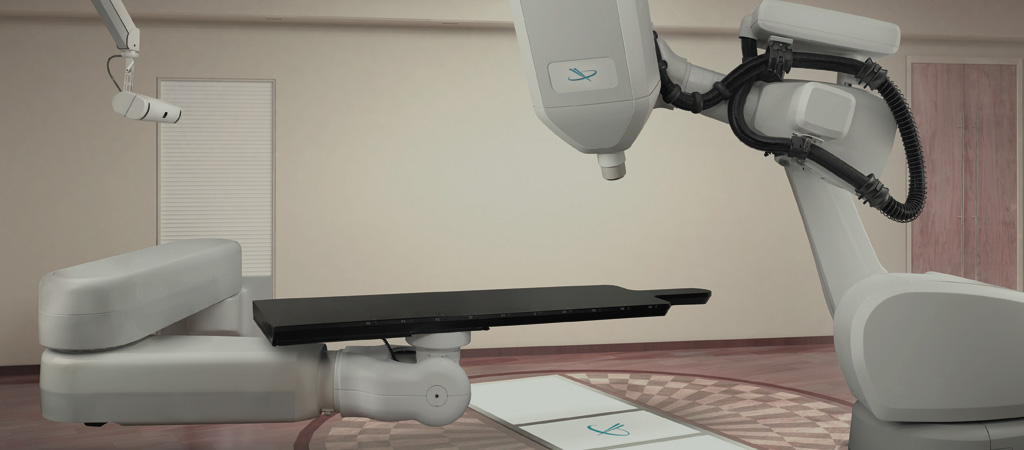
CyberKnife® offers all of the advantages of radiosurgery, but without the need for a metal head frame. Instead, patients are fitted with a more comfortable flexible mesh mask for tumors in the head, or a body cradle for spinal tumors or other tumors outside the head. Because the robotic arm automatically corrects for patient movement during treatment, the CyberKnife® can be used anywhere in the body where radiation is effective.
CyberKnife® was developed by a team of physicians, physicists and engineers at Stanford University. The CyberKnife® technology was cleared by the FDA for intercranial applications in August 1999, and received full-body clearance in August, 2001. It has been used to treat more than 20,000 patients worldwide.
STATE-OF-THE-ART TECHNOLOGY MAKES TREATMENT COMFORTABLE AND EFFECTIVE
Treatment with CyberKnife® results in potentially fewer complications than invasive surgery and often allows patients to have a better quality of life during and after treatment.
Advantages of the CyberKnife® System include:
- Extremely accurate radiation targeting means higher doses of radiation can be used, offering the patient a better chance for cure
- Treats hard-to-reach tumors, many that may have been diagnosed as inoperable
- Tumors receive radiation from many angles, minimizing damage to healthy tissue
- Continually checks and compensates for any movement you make during treatments, ensuring accuracy
- Requires no metal head frame or skull pins
- Eliminates risks related to surgery, including potential infection, complication from anesthesia and post-operative bleeding
- Requires no recovery time. Most treatments are done on an outpatient basis
- Patients undergo their treatment and immediately resume normal daily activities
- Reduces pain
- Requires no or minimal sedation
STEP #1: INITIAL CONSULTATION
The initial consultation involves the radiation oncologist, a surgeon and other physicians if required. If you have a medical oncologist, we will also coordinate our plans with theirs. During your consultation, the procedure, as well as the risks and benefits, will be explained to you in detail. If treatment is to be done on soft tissue, small gold markers, known as fiducials, will need to be implanted into the tumor bearing region. Your doctor will discuss the fiducial placement procedure with you if it is a necessary part of your care.
STEP #2: TREATMENT PREPARATION
Soft Tissue Fiducial Placement
Fiducials are small gold markers that are implanted into soft tissues in or near the tumor (lesion), to accurately guide the CyberKnife® radiation beams. These markers are typically required for tumors in the chest, abdomen, pelvis or other soft tissues, while they may or may not be required for tumors in the spine and are not required for tumors in the brain or skull.
If your treatment requires the placement of fiducial markers within the tumor or lesion area, that procedure will be done by a physician or surgeon and the San Diego CyberKnife® Center staff will make the arrangements for that procedure.
- If fiducial placement is required, there are several things that you will want to keep in mind:
- In most cases, fiducial placement will be done as an outpatient in a radiology facility, and you will be able to return home within an hour or two.
- Prostate fiducials will typically be placed under ultrasound guidance, either by the urologist or by the radiation oncologist.
- Placement of CT-guided lung fiducials may require a hospital-based radiology department, because some of these placements may result in a complication known as a pneumothorax (air trapped in the space between the lung and the chest wall – sometimes referred to as a “collapsed lung”). This complication occurs in about 1/3rd of lung fiducial patients. If a pneumothorax occurs, it may be minor, requiring no further treatment, or it may require a chest tube to remove this air pocket and reexpand the lung, potentially resulting in admission to the hospital overnight.
- Other fiducial placement methods may also be used, such as placing them through a scope that passes through the bronchus or esophagus.
- Our doctors will prescribe the best fiducial placement method for you and our staff will make the necessary arrangements.
- You will not be allowed to eat or drink six to 12 hours prior to the fiducial placement procedure.
- You will need someone to drive you that day.
- You may experience some minor discomfort after fiducial placement.
STEP #3: TREATMENT PLANNING
Making a Mask or Body Immobilizer
Prior to the treatment planning study (CT scan), the first step is to make a plastic mask (used with brain, head or neck tumors) or a comfortable foam body immobilizing system (for tumors everywhere else in the body). These devices are used to help minimize patient movement during treatment. The process is simple and painless.
STEP #4: TREATMENT PLANNING
- CT Scan
- The surgeon and radiation oncologist will use a CT scan to identify the exact size, shape and location of the tumor, along with the surrounding healthy tissues to be avoided.
- The time required for this step is variable, typically lasting from several minutes to several hours, depending upon the complexity of the planning process required.
- When scheduling this appointment, you will receive instructions regarding the CT. You may be given IV contrast (dye). Please let the staff know immediately if you are allergic to the dye.
- This is a painless procedure. We will discuss with you the need for any pre-medication for treatment such as sedatives or pain medications. Please make us aware of any particular concerns you may have.
- In some cases, additional radiology studies such as a MRI scan or a PET scan will also be used in the treatment planning process. If we do this, these extra scans are three dimensionally fused with the planning CT-scan to provide the most detailed map possible of your treatment area.
STEP #5: TUMOR MAPPING/COMPUTER PROGRAMMING
Once your CT studies are complete, your CyberKnife® team will review them in great detail in order to plan your treatment. Planning considerations include exact tumor or lesion configuration and its relationship to adjacent normal body structures, which in turn influences the number, intensity and direction of the radiation beams that the robotic arm will send to the tumor. This will help ensure that a sufficient dose is administered to the tumor in order to destroy it, while minimizing to the greatest degree possible, the radiation dose to the adjacent normal tissue.
When the physicians have completed their work, the physicists will finish the treatment planning. Be aware that this may take a day or longer depending upon the complexity. When the planning is complete, a date and time for treatment(s) will be scheduled. The nurse coordinator will be in touch with you during this time and will confirm with you the treatment date(s) and time(s).
STEP #6: CYBERKNIFE® TREATMENT
- Arriving for Treatment
- You may need to come with a family member or driver if you require sedation or relaxation for treatment. Our staff will review this with you prior to treatment.
- Take any medications prescribed specifically for treatment according to directions on the prescription(s). You should also take your normal daily medications as usual with the exception of diuretics. Diuretics should be withheld until after treatment.
- Wear comfortable clothing and no jewelry. A blanket will be provided for warmth if needed.
- During treatment you will need to lay still. Generally no sedation is required because the treatment is painless, although this will be available depending upon your specific circumstance.
- CyberKnife® treatment will be given 1-5 times depending upon your exact situation. Treatment times may vary from 30-120 minutes. We ask that you plan on spending two hours at the CyberKnife® center each day of the treatment to allow for variability of treatment time, though if more than one CyberKnife® treatment is given, this time estimate may be more exactly tuned after the first treatment.
- You will receive written discharge instructions. Always ask questions if you do not understand a process or instructions!
The CyberKnife Treatment Process
When CyberKnife® treatment begins you will be lying on the treatment couch with your mask or body cradling system, while the imaging system acquires the first set of X-rays in the treatment position. The couch then adjusts to provide the necessary millimeter alignment, and the robotic arm then moves the linear accelerator to its first position and delivers the first treatment beam. This process is repeated many times as the X-ray system re-acquires the target and the robotic arm realigns the linear accelerator from multiple different positions – often greater than 100 times. At each angle, a precise radiation beam is delivered. The image-guidance system utilizes bony landmarks or implanted fiducial markers to track the exact location of the tumor during the entire treatment process, creating an extremely accurate and precise radiation treatment procedure.
If a lung or upper abdominal tumor is treated, the breathing cycle is also continuously tracked and correlated with tumor position, causing the robotic arm to assume a real time “breathing” pattern that tracks the tumor. This robotic breathing pattern exactly follows the tumor as it moves throughout the breathing cycle, keeping the radiation beam squarely on the tumor throughout the entire treatment.
The entire process is painless and usually lasts 30 to 120 minutes. Typically, you may return home and resume normal activities immediately following treatment. If the treatment plan calls for more than one treatment session (known as fractionated CyberKnife® treatment), the radiation therapists will schedule all of the appointment times with you.
STEP #7: FOLLOW UP
We will call you the day after treatment to see how you are doing and will arrange follow-up appointments to monitor your progress. Follow up imaging is generally performed to monitor the tumor’s response to treatment, though the exact study(ies) and their timing will vary with each situation as determined by your participating doctors. You will be given appointments to follow up with the radiation oncologist and surgeon. While waiting for your results, stay busy and maintain a positive state of mind.
Remember to always ask questions if you do not understand a process or instructions!
DIFFERENCES BETWEEN COMMON RADIOSURGERY TECHNOLOGIES
The most widely used radiosurgery devices include: cobalt-sourced systems (Gamma Knife), modified linear accelerators, and the CyberKnife®. All of these devices are capable of delivering the desired radiation dose to a designated target, however there can be important differences between these devices, which may have a significant impact on treatment clinical outcome| CyberKnife® | Gamma Knife® | Other Linac Systems (Elekta Synergy®, Novalis®, Varian Trilogy®, TomoTherapy®) | |
| Radiosurgery Dedicated | Yes | Yes | No |
| Also Does “Conventional” Radiotherapy | No | No | Yes |
| Anatomic Area treatable with Radiosurgical Precision | Brain, Spine, Entire Body | Brain | Brain +/- other selected sites depending upon specific system |
| Rigid Brain or Body Frame Required for Radiosurgical Accuracy | No | Yes | Yes |
| Lesion Size Limitation | No | Yes | No |
| Capable of divided treatments to better preserve adjacent tissues | Yes | No | Yes |
| Continuously adapts to lesion motion caused by organ movement (real time lesion tracking) | Yes | N/A | No |
| Continuously adapts to lesion motion caused by breathing (real time respiratory tracking) | Yes | N/A | Varian Trilogy® uses respiratory gating but does not track with radiosurgical precision – Other systems do not adapt to breathing |

What is stereotactic radiosurgery?
Stereotactic radiosurgery is a non-surgical treatment in which high doses of focused radiation beams are delivered from multiple locations outside the body to destroy a tumor or lesion within the body. This procedure does not remove the tumor or lesion. Instead, it destroys tumor cells or stops the growth of active tissue. Traditional methods relied on a metal frame that was bolted to the skull in order to target the treatment. Because of the need for the metal frame, radiosurgery was not possible for tumors located outside of the head.What is CyberKnife® Stereotactic Radiosurgery?
CyberKnife® is an entirely new approach to stereotactic radiosurgery because it can deliver targeted radiation to anywhere in the body, while minimizing exposure to surrounding normal tissue. It offers all of the advantages of radiosurgery, but without the need for a metal head frame. With sub-millimeter accuracy, CyberKnife® can be used to treat tumors, cancers, vascular abnormalities and functional disorders. Best of all, it achieves surgical-like outcomes without surgery or incisions.How does the CyberKnife® system work?
Using x-ray image cameras and computer technology similar to that used for cruise missile guidance, the CyberKnife® locates the tumor in the body. The medical team then precisely defines the area to be targeted, and the structures to be protected, after which the treatment planning computer evaluates the unique shape and location of the tumor to determine exactly how each of 50 to several hundred or more beams of radiation will target the tumor. A small linear accelerator (high energy X-ray source) located on the CyberKnife’s robotic arm delivers concentrated beams of radiation to the tumor from multiple positions and angles that are selected by the computer to minimize the damage to surrounding tissues. The range of motion offered by the robotic arm gives it maximum flexibility to reach tumor sites not accessible by other means. The CyberKnife® system continually checks and compensates for any patient movement throughout the entire treatment process to ensure accuracy, maximizing the precision of the radiation treatment. Because the CyberKnife has pinpoint accuracy, it can deliver higher doses of radiation to treat tumors, ablating them as effectively as a surgeon’s scalpel, but without the incision.How is CyberKnife® different from other stereotactic radiosurgery systems like Gamma Knife?
The CyberKnife® system uses the combination of a robotic arm, linear accelerator (high energy X-ray source), and image guidance technology. Because of the flexibility of the robotic arm, the system is able to reach areas of the body that are unreachable by other radiosurgery systems. CyberKnife® can be used anywhere in the body, while existing radiosurgery systems typically only offer treatments to the brain and skull base area. The CyberKnife® is able to locate the position of the tumor within the body without the use of an invasive head frame. It monitors and compensates for patient movement during treatment by a unique and very accurate process.Is the CyberKnife® safe?
The CyberKnife® does not present the same problems as traditional surgery. There is no anesthesia, no incision, no bleeding and no post-operative pain or unpleasant anesthesia after effects. Because of its precision, CyberKnife® spares healthy tissue surrounding the targeted area in a manner not achievable with traditional radiation therapy. Over 20,000 people have received CyberKnife® treatments around the world.What can I expect during CyberKnife® treatment?
Treatment follows five steps that may be performed on the same day or on separate days:- Initial Consultation
- Treatment Preparation
- Treatment Planning
- Making a Mask or Body Immobilizer
- CT Scan
- Tumor Mapping/Computer Programming
- CyberKnife Treatment
- Follow-up
After treatment, when will my tumor or lesion disappear?
The effects of radiosurgery occur gradually over a period of time. The time frame may range from days, months or even years depending on the medical condition targeted. Some tumors resolve more slowly than others and may or may not eventually disappear completely, while others simply stop growing and present no further biologic activity. After CyberKnife® treatments patients typically have periodic follow-up imaging examinations, such as CT, MRI or PET studies, as deemed appropriate by their medical team, to assess their progress. Laboratory tests may also be ordered.Will my hair fall out or will my skin burn after CyberKnife® treatment?
The radiation delivered by the CyberKnife® is so focused on a specific target that it is highly unlikely that hair loss or skin burn will occur. In the event that a treated lesion is very close to the scalp or skin though, the adjacent hair or skin may be affected. If so affected, this hair or skin will typically recover over time. All medical procedures, including CyberKnife® treatment, have potential side effects and associated risks, and every patient will be individually evaluated and counseled in detail before a final plan of treatment is made. Any and all questions by the patient and their family will be answered before we proceed with treatment.Is CyberKnife® covered by insurance?
Similar to other forms of radiotherapy and surgical treatment, stereotactic radiosurgery treatments, including CyberKnife®, are usually covered by Medicare and most private insurances. However, in some instances, CyberKnife may be viewed as a “new,” “novel” or “unproven” treatment compared with existing “standard” treatments, and as such, may not be covered by insurance. If insurance denial occurs, our staff will work diligently to educate the insurance company and reverse their decision, though unfortunately, success in reversing their decision is not guaranteed.HILTON GARDEN INN MISSION VALLEY STADIUM
3805 Murphy Canyon Road
San Diego, CA 92123
T 858-278-9300
Check In 3:00PM & Check Out 12:00PM
To book your reservation go to:
https://www.hilton.com/en/hotels/sanstgi-hilton-garden-inn-san-diego-mission-valley-stadium
Click Website, Special Rates, then at drop down menu choose Corporate Account and enter code 2989045
Amenities
- Connecting Rooms
- Free WiFi
- Non-Smoking Rooms
- Digital Keys
- On-site Restaurant with Room Service
- Outdoor Pool
- Fitness Center
- Pet Friendly
- Business Center
HOLIDAY INN EXPRESS
9888 Mira Mesa Blvd
San Diego, CA 92131
T 858-635-5566
Check In 3:00PM & Check Out 12:00PM
To book your reservation go to:
https://www.ihg.com/holidayinnexpress/hotels/us/en/san-diego/sansc/hoteldetail
Corporate Code: 100234034
Amenities
- Free Parking
- Breakfast included
- Free WiFi
- Outdoor Pool
- Fitness Center
- Service Animals only
- Balboa Park: Balboapark.org
- Cruise the San Diego Bay: getyourguide.com
- Old Town Trolley: trolleytours.com
- Seaport Village: Seaportvillage.com
MOVIE THEATERS NEAR BY:
Landmark Theaters
3967 5th Ave. #200
San Diego, CA 92103
AMC Fashion Valley
7037 Friars Road
San Diego, CA 92108